
Criminal Court Cases in Moore County
Moore County belongs to Tennessee's 17th Judicial District with Bedford, Lincoln, and Marshall Counties. Moore County General Sessions Court conducts preliminary felony proceedings and may decide misdemeanors when the accused waives grand-jury investigation and a jury trial. An indicted felony belongs in the district Circuit/Criminal Court. That split matters because one event may begin in the General Sessions index and later appear under a new Circuit case number. A person who asks only for the Circuit number can miss the earlier complaint, bond action, or preliminary hearing.
The Circuit Court Clerk is the custodian to contact for filed Moore County court records. Linda Wolaver is the clerk listed by the Tennessee Administrative Office of the Courts. Judge Terry Gregory is listed for Moore County General Sessions, while M. Wyatt Burk, J.B. Cox, and Forest A. Durard are the district Circuit/Criminal/Chancery judges. Court assignments can rotate within the district, but Moore County filings remain with the Moore clerk. The sheriff holds arrest and booking material, not the final court judgment.
The official 17th Judicial District directory shows the judges and clerks serving Moore County. The captured view preserves that official directory context.
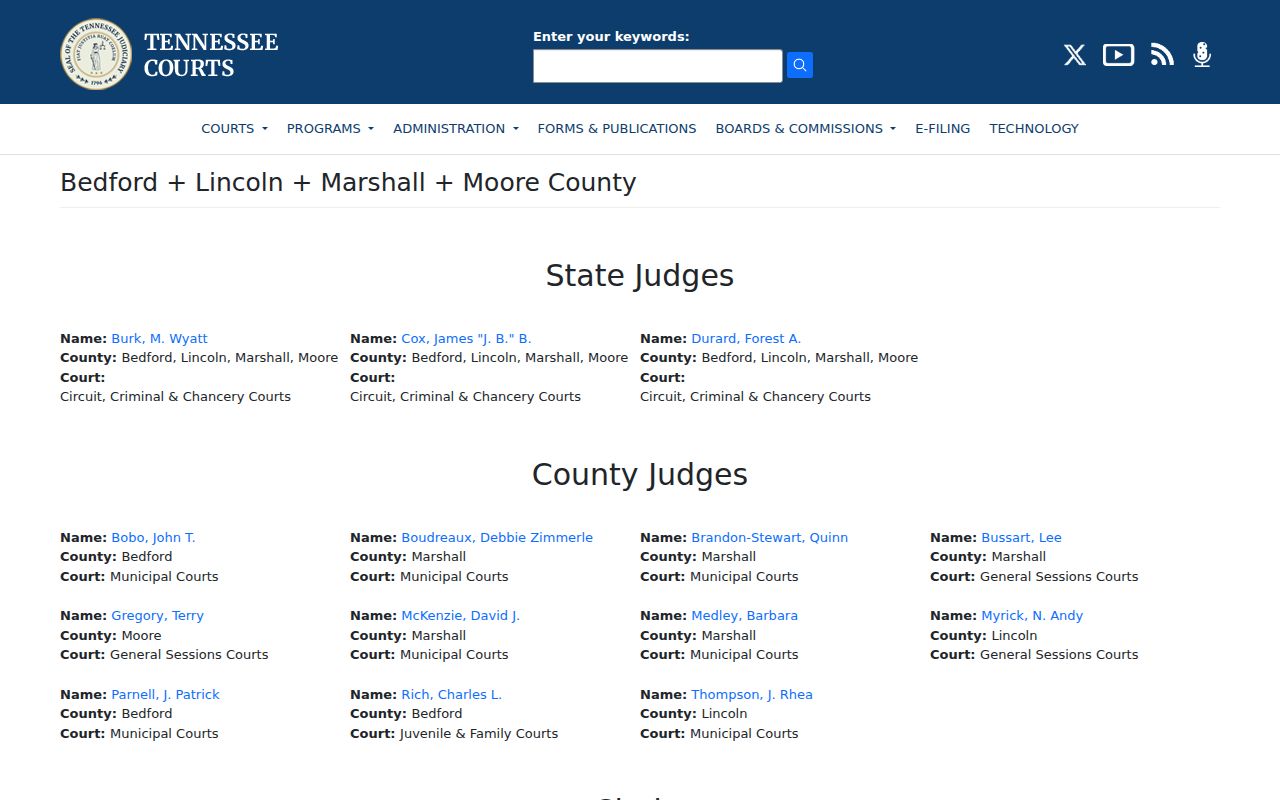
This district listing helps a requester identify the right court without treating a regional judge assignment as a separate place to obtain the Moore County file.
Two Moore County Case Numbers
A felony can leave two linked trails. General Sessions first records the complaint, initial appearance, bail work, and preliminary hearing. If the matter is bound over, the grand jury considers it. An indictment then starts the Circuit/Criminal phase and may receive a different docket number. “Bound over” means the matter advanced for grand-jury consideration. It is not a finding of guilt.
Ask the clerk to search both indexes by full name and an approximate date or year. When either number is found, ask whether the record points to a companion number in the other court. Compare the charges across both files because an arrest allegation can be amended, dismissed, or replaced before indictment. For the broad difference between the booking event and the later case, the Moore County arrest search explains which records stay with the sheriff.
Note: A General Sessions number and a Circuit number may describe stages of one prosecution, not two separate criminal events.
Moore County Case Record Searches
Tennessee has no free, comprehensive statewide trial-court docket search, and no official Moore County online case portal was found. The clerk's phone and counter service are therefore the main search channel. A focused request saves time and avoids paying for pages that do not answer the question.
- Decide whether charges were filed. Ask the sheriff about an arrest report, but ask the clerk for the judicial file.
- Give the clerk the full name, approximate date or filing year, and any known warrant or docket number.
- Request a search of both General Sessions and Circuit/Criminal indexes, including any linked bind-over number.
- Ask for the register or docket sheet first, then select the pleadings, orders, judgment, or sentence that matter.
- Choose plain or certified copies and request the current cost, payment choices, delivery method, and archive time before ordering.
| Search detail | Format | Need | How it helps |
|---|---|---|---|
| Full name | Text | Core detail | Locates party entries; include prior spellings when relevant |
| Case number | Text | Best when known | Points to one docket and its court division |
| Approximate year | Date range | Practical | Narrows manual and archived index work |
| Court level | Choice | Ask for both | Separates General Sessions from Circuit/Criminal records |
| Copy type | Choice | At ordering | Distinguishes a plain copy from a certified court copy |
Moore County Clerk Counter
The official Moore County clerk profile is the best current source for the custodian, rather than a commercial directory. Telephone before traveling. Ask whether the file is onsite, whether older pages require retrieval, what hours are current, and which payment and delivery methods the office accepts. No official Moore County copy fee schedule, remote request form, or dependable courthouse access details were located, so those points should be confirmed with staff rather than assumed.
Moore County Circuit Court Clerk
Courthouse office in Lynchburg, Tennessee
General Sessions and Circuit/Criminal case requests
Current contact details: AOC clerk profile
The official clerk listing was captured for the Moore County court case lookup.
The listing anchors the request to the court's named custodian while leaving changeable hours and copy charges for direct confirmation.
What a Criminal Case File Contains
The docket sheet is the useful first document because it lists the events in sequence. From it, a reader can identify the charging paper, hearing entries, plea, order, judgment, and sentence worth requesting. Moore County has no anonymous online sample docket, so the actual public fields and image availability must be confirmed with the clerk.
| Case Number and Court | Identifies the docket and whether it sits in General Sessions or Circuit/Criminal Court. |
|---|---|
| Charging Document | States the filed counts and statutes, which may differ from the booking allegations. |
| Docket Entries | Chronological filings, hearings, motions, orders, and other public case events. |
| Hearing Dates | Scheduled and completed proceedings recorded by the court. |
| Disposition and Judgment | The count-by-count result, such as dismissal, plea, verdict, diversion, or other order. |
| Sentence and Conditions | Confinement, probation, costs, and other terms stated in the signed judgment. |
Victim identifiers, juvenile information, Social Security numbers, and sealed or expunged material should not be expected in a public copy. A register entry may also omit the detail found in the signed order itself.
Reading Moore County Dispositions
A label on a docket should be read in context and checked against the signed order. The same file may contain several counts with different results. The final Moore County disposition, not the arrest charge or a shorthand status, controls what the court decided.
- Nolle prosequi
- The prosecution ended that count without a conviction, though record clearing can still require a court process.
- No true bill
- The grand jury declined to indict the count.
- Bound over
- The matter moved from General Sessions toward grand-jury review; it is not a conviction.
- Judicial diversion
- Proceedings are deferred under Tennessee law, with a possible later discharge, dismissal, and expungement after successful completion.
- Retired or pass
- An inactive handling term that needs clerk clarification and should not be called a dismissal without an order.
A guilty plea or verdict is followed by a judgment and sentence unless a diversion process changes the ultimate status. If the record uses an unfamiliar code, ask the clerk what that code means on the Moore County docket.
Criminal Case Stages in Moore County
A local criminal matter can begin with an arrest or citation, then move through an initial appearance and bail decision. A felony complaint receives preliminary treatment in General Sessions before possible grand-jury action. After indictment, the Circuit/Criminal Court handles arraignment, discovery, motions, plea talks or trial, judgment, and sentencing. Appeals and later record-clearing orders form separate stages.
Case flow: Charges Filed › Arraignment › Pretrial › Plea or Trial › Disposition › Sentencing
The short flow should not be mistaken for a promise about timing. No reliable Moore County stage-by-stage schedule was published. Continuances, motion practice, grand-jury timing, and archive work can change how long a file remains active.
Older Moore County Court Files
When a name does not appear in the clerk's current index, ask what years are computerized. Older Moore County dockets may remain onsite, sit in another local storage series, or have transferred to the Tennessee State Library and Archives. Give a tight year range and any old case number. Ask staff to identify the record series before placing a broad copy order.
The docket sheet should still come first. It can show whether the old file contains a judgment, later order, appeal notation, or expungement action. For an appellate matter, Tennessee's Public Case History covers appeals, not the Moore County trial pleading file. Federal prosecutions use PACER and the Eastern District of Tennessee's Winchester Division rather than the Moore clerk. Those are separate jurisdictions, not alternate searches for an ordinary county case.
Access Rules for Case Records
The Tennessee Public Records Act supports access to public county records, subject to statutes that make specific material confidential. T.C.A. §10-7-503 sets the inspection framework. If prompt production is not practical, the custodian generally must act within seven business days by producing the record, denying access in writing with a legal basis, or providing an estimate. T.C.A. §10-7-505 provides a route for judicial enforcement.
Public does not mean every page is open without redaction. Juvenile files are restricted under T.C.A. §37-1-153. Victim data, personal identifiers, sealed records, and expunged matters can also be withheld or removed. Ask for the public part and request the statute behind any denial. The Office of Open Records Counsel publishes TPRA guidance and a model request form, plus an official catalog of statutory exceptions.
The official TPRA guidance was captured as a source for Moore County court case access.

This state resource helps distinguish a request for an existing court record from a request that would require an office to create new research or an explanation.
Moore Court Files Versus TORIS
A Moore County court file and a TORIS report answer different questions. The court file shows the prosecution as the clerk recorded it, including the filed counts, docket events, plea, orders, judgment, and sentence. TORIS is TBI's statewide, name-based public history product built from fingerprint-linked arrest cycles and dispositions reported to the repository. It costs $29, does not search aliases, and a possible name match is not biometric proof of identity.
Use the clerk when the goal is to understand one Moore County case or obtain a certified judgment. Use TORIS when a Tennessee repository history is needed, then verify any apparent Moore County match against the court file. Reporting delays, spelling differences, missing fingerprint submissions, or an unreported amendment can cause the two products to differ. Neither FOIL nor a jail check replaces the judgment: FOIL concerns felony custody or supervision, while a jail answer concerns current local custody.
Note: When the court file and a repository report disagree, begin the correction with the office that created the disputed event or disposition.