
Moore County Sex Offender Checks
The Tennessee Sex Offender Registry is the primary public source for Moore County. The Tennessee Bureau of Investigation runs it without a search fee and refreshes it daily from facts supplied by registering agencies. Searchers may focus on Moore County, Lynchburg, a ZIP code, an address, a name, or a TBI offender identifier. The Moore County Sheriff's Department is the practical local contact when the question concerns registration, a reported address, or a possible correction. Its official state-directory listing gives 58 South Elm Street, Lynchburg, TN 37352 and 931-759-7323.
The registry and a criminal-history report answer different questions. A registry result concerns a current statutory duty and the public facts tied to it. It does not display each arrest or every court case. Likewise, no result does not prove that a person has no criminal record. Search the registry for community awareness, then consult court or repository records when the issue is broader than registration status.
Daily Moore County Registry Updates
TBI says the Moore County registry data is updated daily, while its legacy registry search described a nightly refresh. That schedule is useful, but it is not a promise that every field changed at the source will appear at once. Registering agencies supply the data. TBI warns that it cannot guarantee the accuracy of source-agency facts and tells users to support a correction through the agency that registered the person.
A printed or saved profile reflects the day it was viewed. Addresses, supervision details, status, and report dates can change. For a decision that turns on a current fact, check the live profile again and contact the Moore County Sheriff's Department. That extra step is especially sound when a profile uses “Not Available,” because the label means TBI did not receive the directed field information. It is not, by itself, a finding of noncompliance.
Tennessee Sex Offender Registry Searches
The current TBI interface begins with a disclaimer. Its main search accepts one or more terms, while Advanced Search can narrow the result to Moore County, a name, an address, an offender status, or incarcerated profiles. Search options can evolve, so read the labels shown on the live form.
- Open the official TBI registry and accept the lawful-use notice presented by the service.
- Enter a name or choose Advanced Search. Select MOORE under County to focus the list locally.
- Add Lynchburg, a ZIP code, an address, status, or a known TID number when it helps distinguish results.
- Open the matching profile and compare identifiers, address fields, offense details, classification, registering agency, and update dates.
| Field Label | Type | Required | Notes |
|---|---|---|---|
| Last and First Name | Text | Optional | Spelling narrows a person search; aliases may also be searched. |
| City or ZIP | Text or selection | Optional | Use Lynchburg or a known ZIP for a local search. |
| County | Dropdown | Optional | Advanced Search includes MOORE among all Tennessee counties. |
| TID or Offender ID | Text | Optional | A known TBI identifier is more exact than a common name. |
| Address or Map | Text and map | Optional | Address-only searches examine primary, secondary, and employer addresses. |
| Disclaimer | Acceptance control | Required | Acceptance is required where the interface presents it. |
The official TBI search screen shows how statewide controls lead into a Moore County filter.
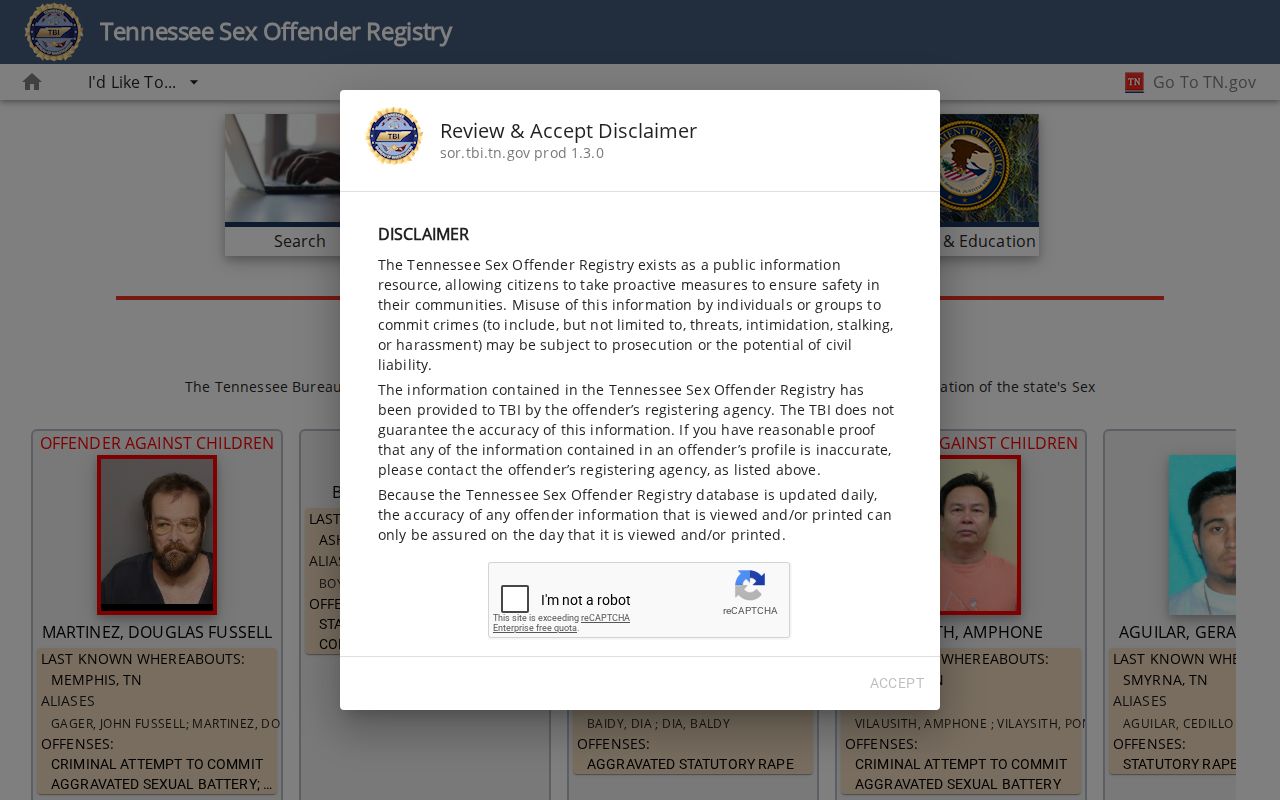
The screen is the right starting point for a current Tennessee registry search, not an unofficial people-search service.
Tennessee Labels for Moore Offenders
Tennessee uses the offense-based labels “sexual offender” and “violent sexual offender.” Those are not simply the federal Tier I, II, and III labels used in some other summaries. Applying a generic national tier to a Moore County profile can produce the wrong view of duration, reporting frequency, or public visibility. Read the profile's Tennessee classification and compare the exact offense with TBI's current statutory quick reference.
Classification is tied to the statute and case facts, not to a reader's estimate of severity. Repeat circumstances and certain victim-age provisions can change the result. A court judgment helps establish what occurred in the case, while the registry shows the present public registration entry. If those sources appear to conflict, the sound course is to verify the judgment and contact the registering agency rather than choosing the record that seems more complete.
Note: A national tier label should never replace the Tennessee classification shown in an official Moore County registry profile.
Registry Profiles: What They Show
A full profile supplies more context than the result table, which may show a photo, name, offender ID, primary and secondary addresses, and a map. TBI's detail layout can include the following fields. Availability varies, and no private person's data is reproduced here.
| Name and Aliases | Displayed name, known aliases, and the TBI offender identifier. |
|---|---|
| Photo and Description | Photograph plus sex, race, height, weight, eye and hair color, scars, marks, and tattoos when published. |
| Address Information | Primary and secondary address, county, and certain school or work indicators when applicable. |
| Offense Information | Offense date, description, Tennessee Code citation, and statutory explanation. |
| Classification | Tennessee sexual-offender or violent-sexual-offender classification, rather than a generic federal tier. |
| Status and Dates | Active, inactive, or incarcerated status plus last update and registration/report dates when supplied. |
| Agency and Supervision | Registering agency, supervision site, and probation or parole officer when provided. |
The TBI profile-field layout provides a neutral view of the fields without featuring a private individual.
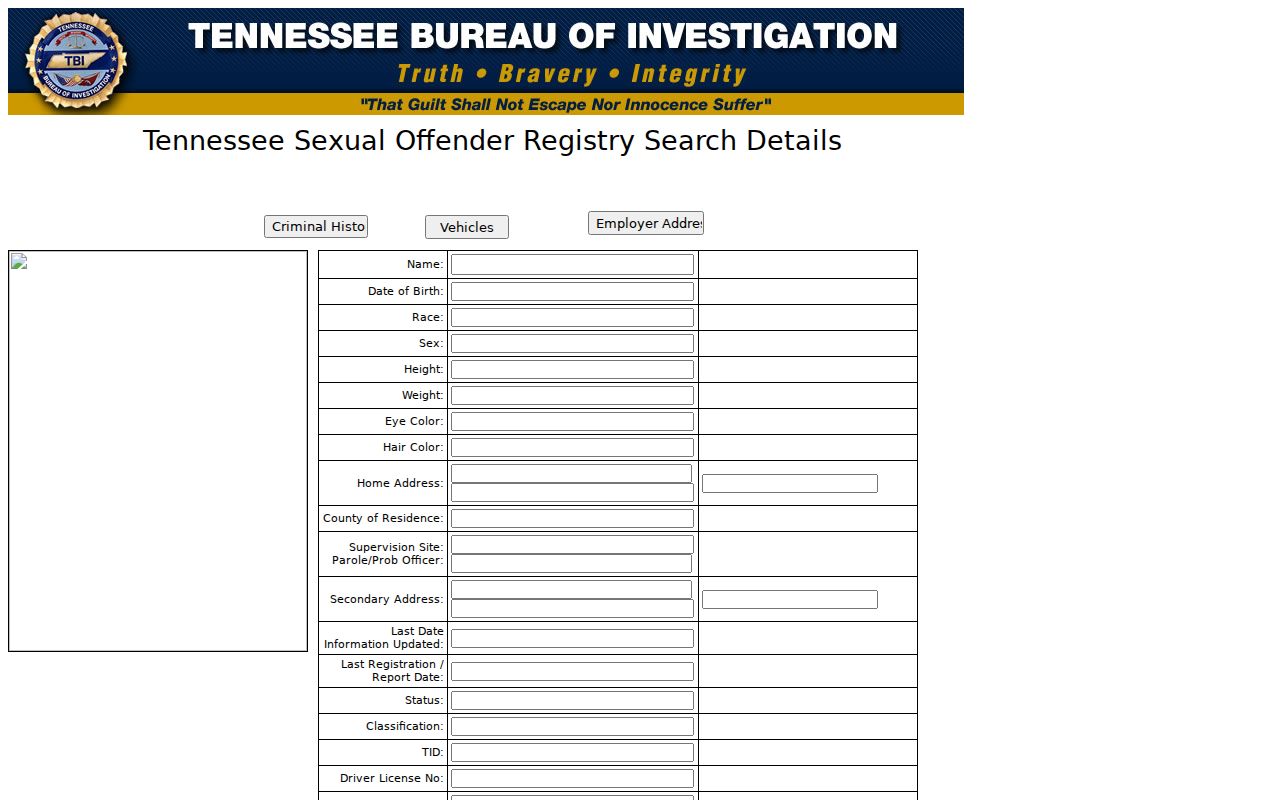
Reading the status, update date, offense, and registering agency together avoids conclusions drawn from a name or photograph alone.
Correcting Moore County Registry Data
A person who sees an apparent error should first identify the disputed field and preserve the profile as viewed. Then gather the court judgment, signed order, address proof, or other source record that supports the correction. TBI directs supported corrections to the registering agency because that agency supplied the public information. For a Moore County entry, telephone the Moore County Sheriff's Department and ask for the local registration contact and current appointment process.
Do not treat the correction process as a public accusation. A late field, a blank date, and a disputed classification call for different source records. If the issue concerns a conviction that was overturned, vacated, or expunged, that is distinct from a request to end registration under T.C.A. §40-39-207. Keep certified court orders, note whom the agency asked to receive them, and check the registry again after the source has had time to act.
Registration Levels and Duties in Tennessee
Tennessee's reporting pattern turns on its statutory classification. TBI states that a sexual offender generally reports once each year within seven days before or after the birthday. A violent sexual offender reports quarterly during March, June, September, and December. Required-information changes generally must be reported in person within 48 hours. Social-media screen names, email addresses, and online identifiers follow a 72-hour reporting rule.
| Tennessee Class | Duration | Verification Pattern |
|---|---|---|
| Sexual offender | Generally at least ten years after active supervision ends, subject to eligibility and §40-39-207 | Generally annual, near the birthday |
| Violent sexual offender | Generally lifetime | Quarterly in March, June, September, and December |
| Specified lifetime cases | Generally lifetime for listed circumstances, including certain repeat offenses or victim-age rules | Follow the classification and current TBI direction |
Ten years and lifetime are starting points, not safe shortcuts for an individual case. Certain offenses and repeat circumstances alter classification. Termination requires the statutory request or petition route and proof of the conditions in current law. The Moore County Sheriff's Department can confirm where a resident reports, but only the actual offense, judgment, and law settle classification.
National Searches Beyond Moore County
A Moore County filter is useful for a local address, but it cannot follow someone across state lines by itself. The U.S. Department of Justice operates the National Sex Offender Public Website, or NSOPW, as a search layer across participating jurisdictions. Use it when a known location may fall outside Tennessee or when a name search should cover more than one state.
NSOPW links back to the jurisdiction that owns the underlying profile. Search results can differ because public-display laws and update practices vary. Confirm the information on that jurisdiction's official page. The national interface supplements the TBI registry; it does not convert a registry search into a full national criminal-history report.
The DOJ's national search entry shows the cross-state service used when a Moore County-only search is too narrow.
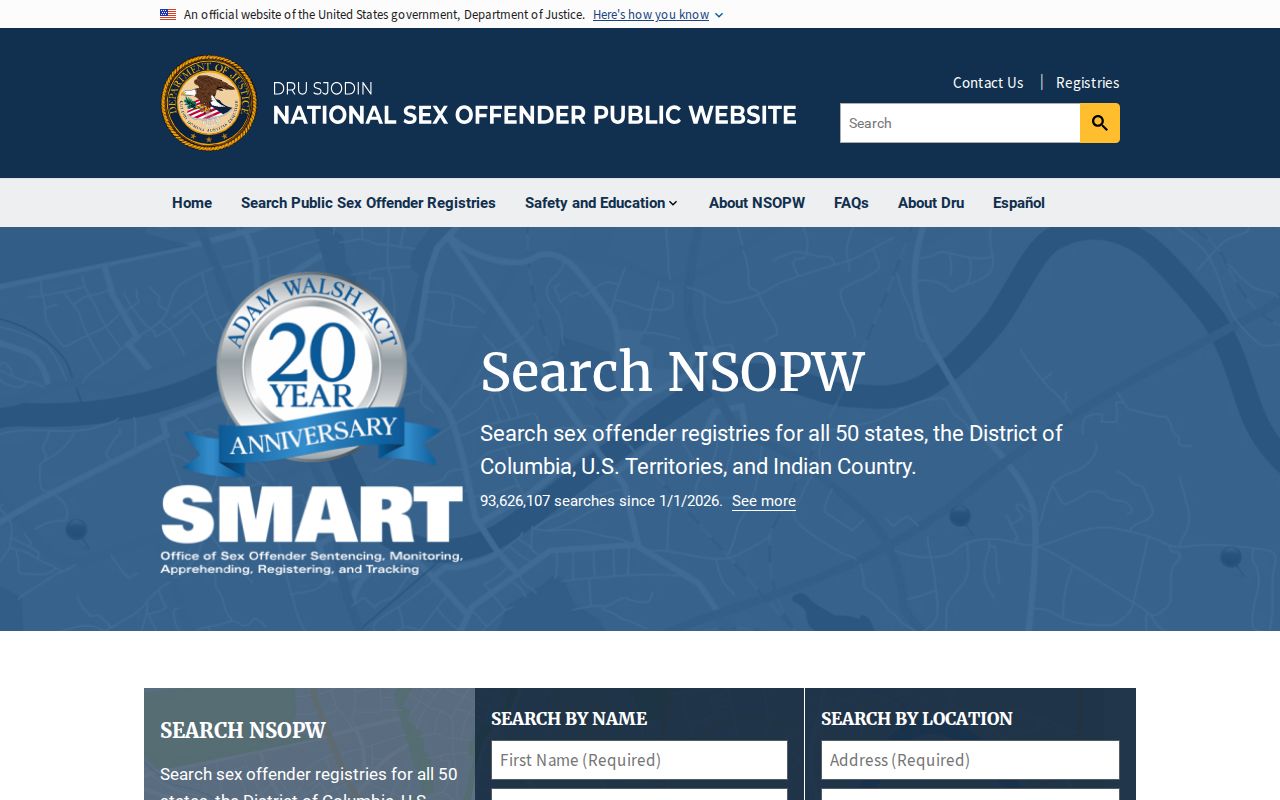
The source jurisdiction remains the place to verify a match, its current status, and the meaning of each displayed field.
Registry Absence and Criminal Records
An empty Moore County result can mean several things. The search terms may be too narrow, the person may use a different name, the address may be outside the selected area, or a record may not be publicly displayed under Tennessee law. Violent juvenile sexual offenders are not displayed on the public website. More fundamentally, most criminal cases do not create a sex-offender registration duty at all.
For those reasons, registry absence is not a clean criminal-history finding. A broader question should move to the clerk, TORIS, or the relevant official source. The Moore County criminal-history overview explains how local court, sheriff, repository, and correction sources answer different parts of a record search. Keep the registry task narrow: identify public registration information and confirm it through the proper agency.
Using Registry Information Lawfully
Registry information supports personal safety and community awareness. Read it carefully, verify time-sensitive facts, and use public contact channels when a correction or compliance concern needs attention. Do not confront a person based on a profile. Do not republish the entry as proof of new conduct. TBI warns that threats, intimidation, stalking, harassment, and retaliation can lead to criminal prosecution or civil liability.
Misuse warning: T.C.A. §40-39-201 et seq. governs Tennessee's registry. Using Moore County registry information to threaten, intimidate, stalk, or harass can be a crime and can create civil liability.
Report a well-supported concern to the Moore County Sheriff's Department rather than trying to enforce the registry yourself. Supply the profile identifier and the precise fact at issue. For immediate danger, use the appropriate emergency channel. Community awareness works best when the source is official, the match is checked, and legal limits are observed.